
* Panel 1 stretches across top of the page with the title incorporated into the artwork. Panels 2-10 are arranged in a standard 9-panel grid.
* As in an early McCay strip, captions should include panel number, and run through the white-space UNDERNEATH the associated panel. Captions carry over from one panel to another, as in McCay. See here for reference.
Panel 1 – The giant MAGOOZLA, a sort of large demon frog, is speaking to LUNATRIX (a clownish, star-faced servant). They stand outside the entrance of a train-tunnel that’s been cut into the side of an underwater mountain—they are lit by a glow that emanates from inside the tunnel (think: Smaug’s lair in Tolkien’s The Hobbit.) Around the tunnel entrance are hydrothermal vents, gushing blue-black smoke and bubbles: pale green and red tubeworms live around the vents, where they feed. Reference image. (Comic title should be incorporated into panel’s artwork in McCay style—see above.)
TITLE: THIRTY-SOMETHING NEMO IN SLUMBERLAND
MAGOOZLA: The Princess is inconsolable. Fetch Nemo!
LUNATRIX: Oh, it’s been years – I pray he’ll come!
Panel 2 – (Classic McCay side-view of bed.) NEMO, a middle-aged bearded man in t-shirt and boxer shorts, sits up in bed. He is exhausted and relieved as he has awoken out of a dream. But around him, the room is flooded up to the level of the mattress. The water is higher on the right-hand side of the panel—emphasizing that the water is coming from that direction
NEMO: O, Mama. What a terrible dream!
CAPTION: {#1} Waking from a dream in which I was being waterboarded for something I hadn’t done, I discovered
Panel 3 – Waist-deep in water, NEMO walks toward the bathroom door at the right side of the panel—his hands are raised in a gesture of disbelief. Water is pouring out of the bathroom door—as though the bathroom is completely full of water and it’s spilling over an invisible force-field into the bedroom.
NEMO: What the what? Did I leave the faucet running?
CAPTION: {#2} my bedroom had flooded. I hurried toward the bathroom, keen to discover what was wrong. But I
Panel 4 – A floating NURSE speaks to NEMO as he too floats, panicked, in a flooded train station. Because the bathroom is no longer a bathroom, but an underwater train station that is for some reason being used as a hospital. Water fills the whole panel now. The train station is like one of those London or Paris stations with the high-vaulted glass ceilings, and many parallel tracks, but only one waiting train to Slumberland. There are gurneys and operating tables on the train platforms—nurses and doctors calmly treating white-clad patients (think the M.A.S.H. operating theater as in this reference.) The tables et al are secured to the ground, but the doctors and nurses are floating in the water.
NEMO: What…But I can’t breathe underwater!
NURSE: Of course you can, Nemo. We’ve been able to for years!
CAPTION: {#3} found myself in an underwater train station being used as a triage hospital. A passing nurse calmed my
Panel 5 – LUNATRIX waves to NEMO, who has now floated further into the station. Lunatrix is standing over a hospital gurney, holding a VHS videotape in his raised hand. On the gurney are a beat-up old cardboard box, and a glass jar filled with red flower heads. Next to the hospital gurney is a big-box TV and VHS player from the early nineties. Behind them the train to Slumberland remains visible.
LUNATRIX: Ah, there you are, Nemo!
LUNATRIX: We need to catch that bullet train to Slumberland! The princess…
CAPTION: {#4 } fears of drowning. Then I saw Lunatrix, and I knew I was returning to Slumberland after all these
Panel 6—As he returns his attention to the box of videotapes, LUNATRIX hands NEMO the GLASS JAR.
NEMO: What are you looking for?
LUNATRIX: Here, hold this a second.
LUNATRIX: I just need to find the home video of your birth! We can’t leave without it!
CAPTION: {#5} sad years! As he continued rifling through my old Star Trek videos, he handed me a jar full of beautiful
Panel 7—NEMO opens the glass jar just a little bit. LUNATRIX, his back to NEMO, is putting a videotape into the VCR.
NEMO: O, how beautiful! I wonder if these flowers smell like the ones…
LUNATRIX: Is this the one?
CAPTION: {#6} flowers. They reminded me of the blood-colored blossoms that we saw that night by the swimming
Panel 8—NEMO drops the glass jar in shock as the blossoms inside explode into a wild thicket of reaching vines that begin to fill the panel. Hearing what NEMO said in last panel, LUNATRIX has turned to try to stop NEMO, but it’s too late. The idea here is that when water is added to these flowers, they grow like crazy—expanding without end. Like those little capsules you add water to and foam dinosaurs burst forth.
LUNATRIX: No, don’t open that!
NEMO: O no!
CAPTION: {#7} pool. But when I opened the jar, the blossoms exploded in a storm of reaching, choking vines. I tried
Panel 9—NEMO and LUNATRIX are overtaken by the mad, flowering vines. We can see that the jar was caught by the vines before it could hit the ground. The vines and blossoms fill the whole panel—we should see faces and hands, but otherwise only solid vegetation. Red should be the overwhelming color in this panel.
LUNATRIX: Oh no! Wait Nemo! We can still catch the train!
NEMO: I can’t breathe! O mama, papa!
CAPTION: {#8} to reach Lunatrix, but the flowers were drowning me. I knew I must try to catch this train to Slumberland
Panel 10—NEMO is back in his bedroom—he’s fallen half out of bed, tangled in his bedsheets. His toddler DAUGHTER stands next to the bed in her pajamas (covered with frogs and toads echoing MAGOOZLA a little bit), scratching her head.
DAUGHTER: What happened, Daddy? Did you eat more chocolate ice cream before bed?
CAPTION: {#9} but then I woke up.
Showing posts with label Colin Cheney. Show all posts
Showing posts with label Colin Cheney. Show all posts
Monday, September 14, 2015
Sunday, September 13, 2015
Why Little Nemo in Slumberland? - Colin Cheney
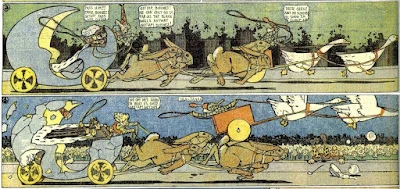
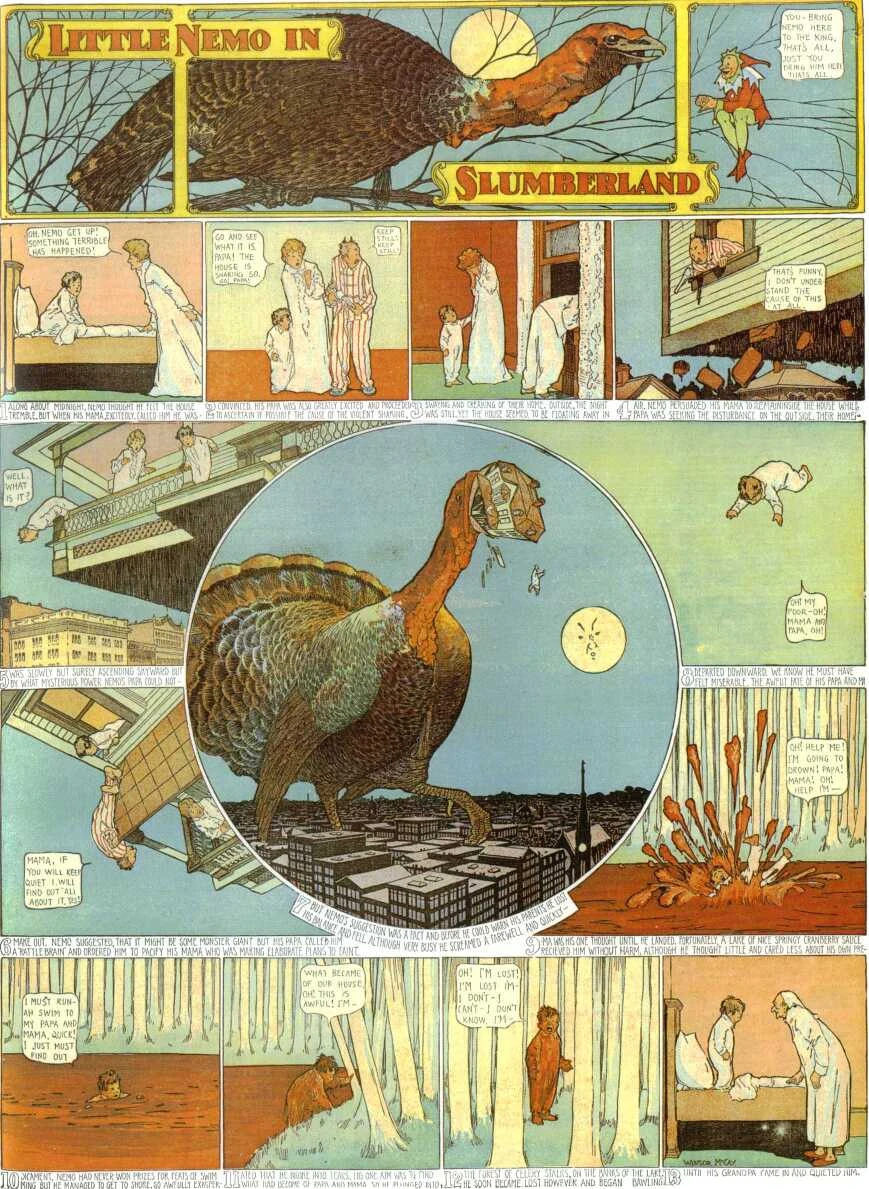
Many readers are no doubt already familiar with Winsor McCay’s classic comic strip, Little Nemo in Slumberland. But, if you’re not, they basically involve a young boy embarking on journeys into various dream realms. McCay created these dynamic, wildly colorful, 22” x 17” full-page comic strips during the first two decades of the twentieth century. And his work has influenced a great many comics creators, as well as filmmakers and children’s book authors (many kids are first introduced to Little Nemo unknowingly through Maurice Sendak’s homage to McCay, In the Night Kitchen).
So I decided to set us up with this thoughtballoons prompt—to write a dream-based comic in the spirit of McCay’s Little Nemo strips—for two reasons.
First, I thought it’d be fruitful to muck about inside the mechanics and imagination of McCay’s storytelling. A hundred years ago, McCay was confronting challenges of sequential art with which contemporary creators still wrestle. How does each panel work on its own, while contributing to the full page’s visual integrity? How does the eye move between panels, and across the page, and what effect does this movement have on the reader’s imagination? Though his style evolved over the strip’s run, McCay had very particular rules that he worked out for himself—and I wanted to see what it was like to play (roughly) by his rules.
(For example, as I worked on my own Nemo-inspired comic, I found myself thinking a lot about how McCay’s early strips set up Nemo’s adventures in the first panel. During 1905, McCay would begin each comic with a panel in which one of King Morpheus’s courtiers sets in motion a plan to fetch Nemo. During that first year of strips, Nemo never actually reaches Slumberland—some crisis emerges in the penultimate panels causing him to wake, disheveled in his bedsheets, in the final panel. While neither the dream-folks’ plan to fetch Nemo nor the boy’s own journey is achieved, the arc of each page-long story is clearly established in that first panel. I wanted to see if I could incorporate that structure and approach in my own comic.)
Second, I thought it would be interesting to muck about with actual dream material. Everyone knows that telling someone else one of your dreams nearly always leads to a glazed, bored expression. Even if we can recognize certain shared concerns or anxieties, another person’s dreams are just too specific to her own subconscious—the hodgepodge of data drifting about in each of our strange mental landscapes. But when I was reading McCay’s strips, I was struck by how he seemed to have such a good grasp on the way dreams can work: the narrative logic used in some of McCay’s early strips seemed familiar to me.
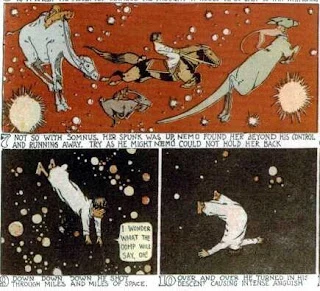
So, in putting forward this prompt to the thoughtballoons crowd, I wondered what would happen if we channeled one of our own dreams—in all its particularity and oddness—through McCay’s storytelling form. How much of a dream’s non-narrative nature can be kept intact as we translate it into a one-page story with a beginning, middle, and end? How do we write our memory of a dream for another artist — perhaps a stranger—to draw?
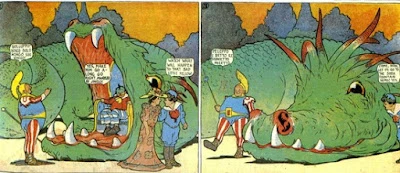
The story should be in the spirit of McCay’s early twentieth-century strips: usually Nemo drifting off to sleep, finding his way into Slumberland (realm of dream and nightmare), with a final panel that interrupts the dream as Nemo wakes in bed, back in the real world. The idea here is to see what happens when you give Nemo one of your own dreams or nightmares to explore.
If you like, as a bonus, mess about with McCay’s caption and dialogue style: he often included footer captions narrating each panel, plus dialogue.
For reference, there are a bunch of the strips online, but here’s a handy glimpse at a few.
Second, I thought it would be interesting to muck about with actual dream material. Everyone knows that telling someone else one of your dreams nearly always leads to a glazed, bored expression. Even if we can recognize certain shared concerns or anxieties, another person’s dreams are just too specific to her own subconscious—the hodgepodge of data drifting about in each of our strange mental landscapes. But when I was reading McCay’s strips, I was struck by how he seemed to have such a good grasp on the way dreams can work: the narrative logic used in some of McCay’s early strips seemed familiar to me.
So, in putting forward this prompt to the thoughtballoons crowd, I wondered what would happen if we channeled one of our own dreams—in all its particularity and oddness—through McCay’s storytelling form. How much of a dream’s non-narrative nature can be kept intact as we translate it into a one-page story with a beginning, middle, and end? How do we write our memory of a dream for another artist — perhaps a stranger—to draw?
The story should be in the spirit of McCay’s early twentieth-century strips: usually Nemo drifting off to sleep, finding his way into Slumberland (realm of dream and nightmare), with a final panel that interrupts the dream as Nemo wakes in bed, back in the real world. The idea here is to see what happens when you give Nemo one of your own dreams or nightmares to explore.
If you like, as a bonus, mess about with McCay’s caption and dialogue style: he often included footer captions narrating each panel, plus dialogue.
For reference, there are a bunch of the strips online, but here’s a handy glimpse at a few.
3 comments:

Monday, September 7, 2015
Concert Posters - “Lord, it done rose everywhere”* - Colin Cheney
Panel 1 – A collection of shipping
containers are stacked, three-high, by the side of a rural train
track. It’s getting on toward dusk.
Panel 2—A massive flash flood of
sand-colored water (as high as second stack of containers) hits the
containers, setting them free in the fast moving, roiling water.
Other debris is visible in the water: tree branches, deck chairs,
etc.
SFX: KRASTSH!
Panel 3—The containers (some pitched
at an angle, others more-or-less righted) float through a flooded
town on the fast-moving, white-brown water.
SFX: WSSH
SFX: WSRUSH
SFX: WSRUSH
Panel 4—Medium shot of a teenage boy
clinging, precariously, to a high branch of a tree above the
floodwaters. He is watching the containers coming toward his tenuous
refuge.
Panel 5—Boy jumps onto the container
as it passes on the floodwaters beneath his tree.
Panel 6—Night has fallen. Boy rides
container—now separated from the others—through a flooded
landscape of rooftops and treetops. Upended cars, a dog on a rooftop,
mailboxes, etc can be seen in the dark waters.
Panel 7—Boy sees glaring halogen
lights of rescue boats surrounding a levee off in the distance.
Panel 8—Boy yells toward the
too-distant-to-hear rescue boats—his shipping container is moving
by too fast, carrying him away from safety.
BOY: Hey! Over here! Help!
BOY: No, no! Wait, I’m here!
Panel 9—Medium-to-long shot of boy on
shipping container as it is carried out into a flat, endless sea of
water. Stars shining above.
* Lyric from Charlie Patton, “High
Water Everywhere, Part 1”
1 comment:
Sunday, September 6, 2015
Colin Cheney - Writer-in-Residence
We've come to a new fortnight (people still use fortnight, right?) and with it a new writer-in-residence to join us here at Thought Balloons.
First, let me bid farewell to Liam Lachance. It was a pleasure to have you aboard and we hope to see you around again someday. And secondly, let me wish a warm welcome to Colin Cheney.
I recently took a writing course through Andy Schmidt's Comics Experience, and it was nice to take some time to focus on the basics of comic writing and consider the hows and whys of the medium. It never hurts to get your craft game on, but the other part of the course that I thoroughly enjoyed was getting to know my fellow classmates.
There were plenty of talented writers, some who were wet around the ears and others who had been hustling for a good while. It was a pleasure to get to know them and to throw thoughts and feedback their way on the comics they were writing - something that we're all about here at Thought Balloons.
Of all those scripts I read during the course, Colin's was one that jumped out at me. From the beginning, his story idea seemed ambitious. It had a young family struggling to deal with their new home in a foreign land, their own interpersonal conflict, and some fantastic elements sprinkled in for good measure. It looked overwhelming, but I was amazed and impressed to see him tame and reign the story in, while maintaining all those original elements.
I figured he would be a good fit as our next Writer-in-Residence, and he graciously agreed. I look forward to seeing what he'll come up with these next two weeks.
And for your reading pleasure, here's a bit more biographical info on Colin:
First, let me bid farewell to Liam Lachance. It was a pleasure to have you aboard and we hope to see you around again someday. And secondly, let me wish a warm welcome to Colin Cheney.
I recently took a writing course through Andy Schmidt's Comics Experience, and it was nice to take some time to focus on the basics of comic writing and consider the hows and whys of the medium. It never hurts to get your craft game on, but the other part of the course that I thoroughly enjoyed was getting to know my fellow classmates.
There were plenty of talented writers, some who were wet around the ears and others who had been hustling for a good while. It was a pleasure to get to know them and to throw thoughts and feedback their way on the comics they were writing - something that we're all about here at Thought Balloons.
Of all those scripts I read during the course, Colin's was one that jumped out at me. From the beginning, his story idea seemed ambitious. It had a young family struggling to deal with their new home in a foreign land, their own interpersonal conflict, and some fantastic elements sprinkled in for good measure. It looked overwhelming, but I was amazed and impressed to see him tame and reign the story in, while maintaining all those original elements.
I figured he would be a good fit as our next Writer-in-Residence, and he graciously agreed. I look forward to seeing what he'll come up with these next two weeks.
And for your reading pleasure, here's a bit more biographical info on Colin:
Colin Cheney is a poet and writer who lives in Bangkok, Thailand, with his wife and two kids. His book, HERE BE MONSTERS, was published in 2010 by the University of Georgia Press, and his poems show up every now and again in print and online magazines. Recently, he recorded some poems for a great little online project, FROM THE FISHOUSE. A lifelong comics fan, he’s been collaborating on a couple of comics with friends in Bangkok and elsewhere—and hopes to have them out in the world in the next year or so. Occasionally, very occasionally, he has been getting thoughts about comics up .
No comments:
Subscribe to:
Posts (Atom)